

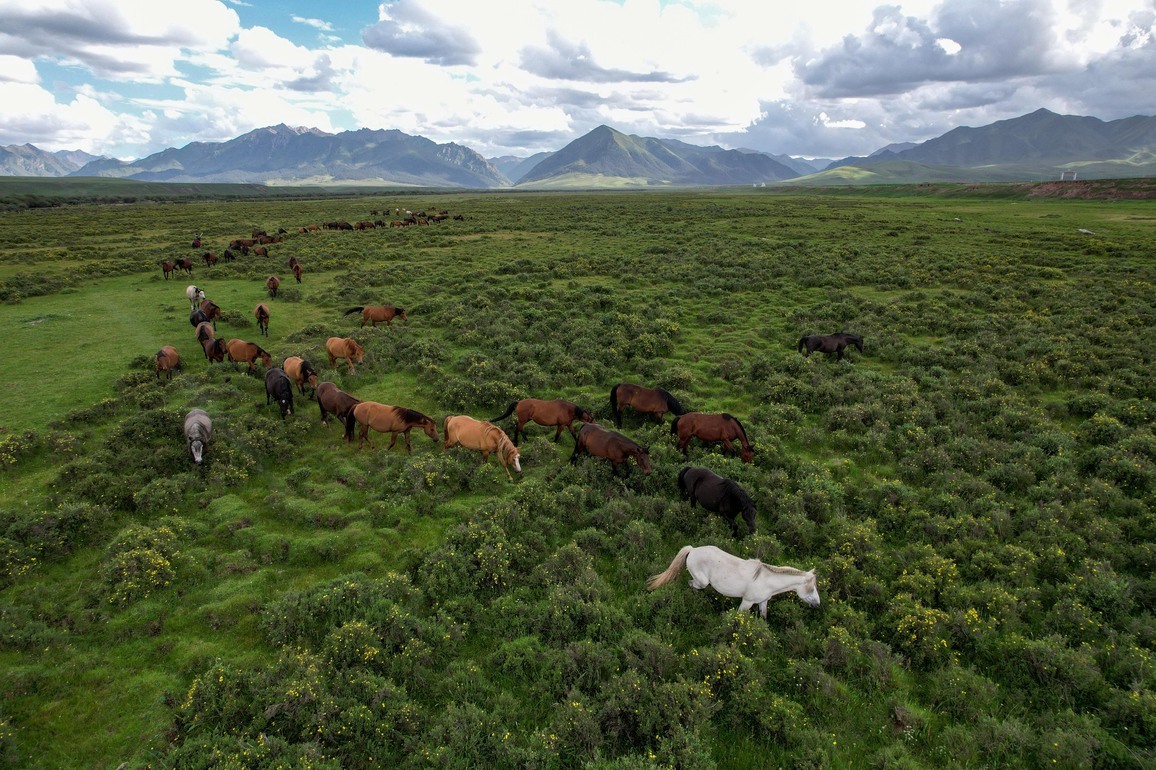
LANZHOU, June 8 (Xinhua) -- A new study has shown that grassland restoration under China's grassland ecological compensation approach helps enhance maize yields through local climate regulation, providing new insight into the relationship between ecosystem protection and food security, according to Lanzhou University.
This study for the first time systematically revealed that large-scale grassland restoration can significantly enhance crop yields by regulating local climate, demonstrating that ecosystem conservation and agricultural development could be mutually reinforcing, the university said.
The study is led by a research team at the College of Pastoral Agriculture Science and Technology of Lanzhou University, in collaboration with researchers at multiple universities and research institutions at home and abroad. Its findings have been published in the journal Nature Climate Change.
The conventional view that ecosystem conservation and food security are in a competitive, zero-sum relationship, has profoundly influenced policy-making in agricultural regions around the world. "Our study breaks with the conventional idea that a trade-off between the two is inevitable," said Liu Min, a professor at the College of Pastoral Agriculture Science and Technology of Lanzhou University.
Researchers utilized the implementation of China's grassland ecological compensation policy as a quasi-natural experiment.
The policy represents one of the world's largest ecological restoration initiatives. It controls overgrazing through measures such as grazing bans and livestock-forage balance, while providing corresponding subsidies to herders. Implemented nationwide in phases starting from 2011, the policy expanded gradually from the initial 66 counties to 242 counties by 2016.
The team studied the results of this phased roll-out, employing a staggered difference-in-differences approach to systematically assess the causal effects of this policy on local climate and crop yields.
The study found that restored grasslands reduce growing-season temperatures by 0.1 degrees Celsius and increase precipitation by 11.48 mm, thereby mitigating heat and drought stress during critical reproductive stages.
Such local climate regulation effect is of significance to agricultural production. Given the possible condition of the RCP4.5 climate change scenario -- a medium-level pathway for future climate change -- over the next two decades, spring-maize planting regions in northern China are projected to warm by 0.5 to 1.5 degrees Celsius with precipitation decreasing by approximately 25 mm.
It means that the cooling effect brought by grassland restoration could offset 7 to 20 percent of the expected warming, according to Liu.
"The core insight of the study is that ecosystem conservation and food security are not a zero-sum competitive relationship. Grassland restoration achieves a synergistic effect of 'boosting production through protection' by regulating local climate," Liu said.
Liu said the new finding also has important policy implications for agricultural regions worldwide in their efforts to build a climate-resilient agricultural sector, especially for regions similar to the studied areas.