

CHONGQING, June 5 (Xinhua) -- For centuries, the wind swept through China's Gobi Desert and grasslands remained largely untouched by development. Now, rows of towering wind turbines and sprawling solar farms stretch across the horizon, reshaping the landscape and powering the country's green transition.
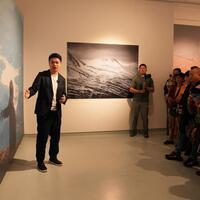
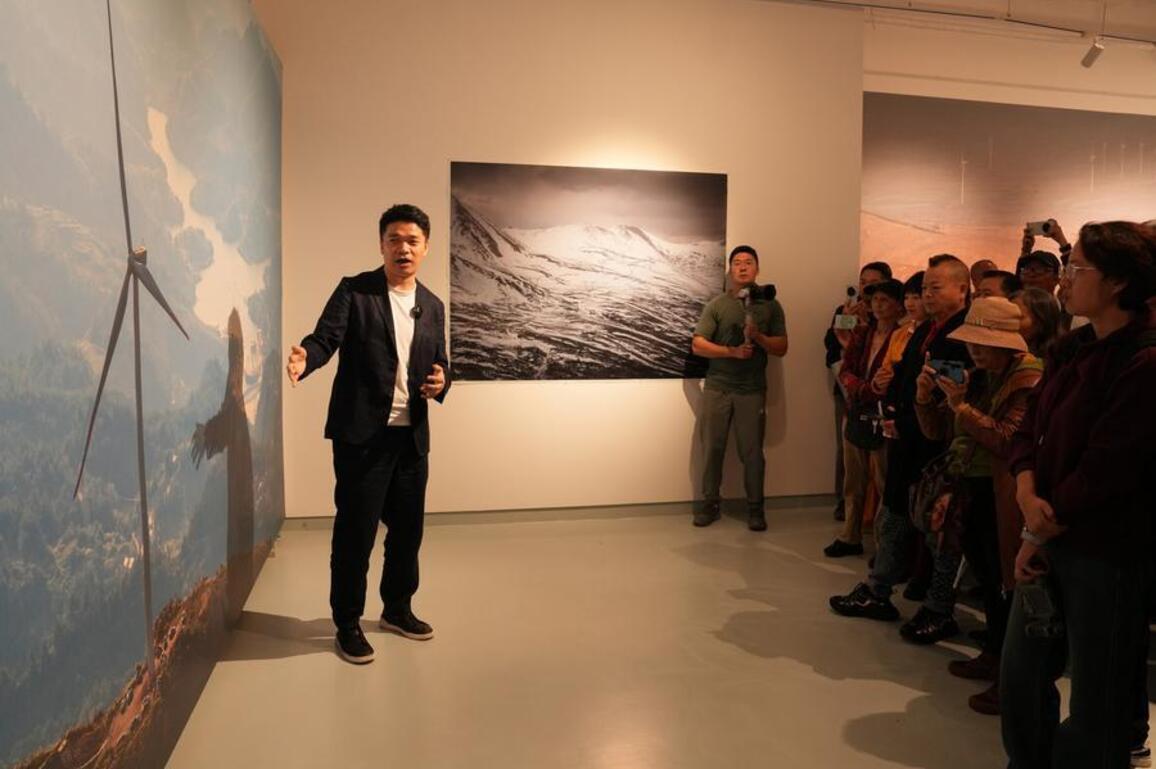
Among those capturing this transformation is Chinese photographer Chu Weimin. Over the past six years or so, the 36-year-old has traveled through some of China's most remote regions, using landscape photography to document China's renewable energy boom. Since last year, a selection of his works has been exhibited in several cities under the title Green Future.
As Friday marks World Environment Day, Chu's collection is on display at Chongqing Starring Art Museum, located in Chu's hometown -- southwest China's Chongqing Municipality. The exhibition features over 50 images captured across a dozen provincial regions -- mostly in the west but also along the east coast -- and runs until June 10.
Using drones, Chu gained a bird's-eye view of the immense scale of China's renewable energy infrastructure. His camera soared over a remarkable variety of landscapes -- from vast solar farms in the Gobi Desert of the northwest and offshore wind farms along the eastern coast, to mountain ridges in the southwest blanketed with solar panels, and the engineering feat of ultra-high-voltage transmission lines carrying electricity across great distances to power fast-growing cities.
However, the images are anything but cold or lifeless. Chu's deft use of light and composition lends a poetic touch to industrial landscapes: the first rays of dawn glinting off solar panels, the moon ascending above wind turbines beneath a pink-purple dusk, and turbines etched against snow-covered golden terrain.
"Through his lens, the geometric lines of solar panels echo the gentle contours of grasslands and deserts, while the silhouettes of wind turbines blend seamlessly into the sky," said Li Jiongzheng, a local public officer, after visiting the exhibition. Such scenes, Li noted, challenge the notion that industrial infrastructure must come at the expense of nature.
Equally compelling is the contrast between the smallness of individuals and the magnitude of their impact, Li commented. "In close-up shots, workers inspecting equipment appear tiny against vast energy installations, yet it is precisely these seemingly small efforts that are reshaping the future of energy on Earth."
While explaining his inspiration, Chu told Xinhua, "When I was traveling across China, photographing natural landscapes, I noticed that whether I was in the Gobi Desert of Qinghai or among the snow-capped mountains of Xizang, every time I sent up a drone to take photos, I could see wind turbines and solar panels in the distance."
China has become the world's leading driver of robust growth in the renewable energy industry. By the end of March, China's total installed renewable energy capacity reached 2.395 billion kilowatts, up 22 percent from a year earlier, accounting for 60.4 percent of total installed power capacity.
Much of the capacity has been installed in sparsely populated but wind- and solar-rich northwestern regions and on degraded land including rocky desertification areas in southwest China's Guizhou and abandoned mine areas.
In the Talatan Gobi Desert, Chu witnessed how solar panels not only alter the power mix but also reshape ecosystems. In areas where the panels have been installed, vegetation has gradually returned, as the structures provide shade from intense sunlight and help reduce wind erosion.
To control vegetation growth, the solar energy base invited nearby villagers to graze their sheep beneath the panels. Chu's lens captures this striking juxtaposition of grazing sheep and orderly rows of solar panels. The scene has become an iconic symbol of the integration of clean energy and rural livelihoods.
The entire Talatan new energy base is also showcased in a massive stitched panorama with a resolution of 800 megapixels at the exhibition. Chu explained that at the center of the image stands a photovoltaic power plant already connected to the grid, alongside another still under construction. Beneath them stretches a vast sea of densely packed solar panels.
"Through this photograph, you can truly appreciate the immense scale of the Talatan renewable energy base," Chu said.
Some of Chu's photographs capture a striking dialogue between the past and the future, juxtaposing renewable energy installations -- symbols of modern engineering -- with historical relics and fading industrial infrastructures.
In one image taken in Wuzhong, northwest China's Ningxia Hui Autonomous Region, an ancient section of the Great Wall stretches across the foreground, while towering wind turbines rise on the horizon. The composition brings together centuries of human endeavor in a single frame, juxtaposing a symbol of China's past with one of its future.
In Lenghu Township of Qinghai, Chu witnessed how the renewable energy industry revitalized a declining town deep within the arid Gobi Desert. The town gradually fell into decay as local oil reserves were depleted, with its population dropping to just a few dozen at one point. Now, people are starting to gather here again, both due to booming tourism and the construction of large-scale wind and solar power bases.
"Since renewable energy generation is sustainable and requires long-term maintenance, it provides stable employment for the locals," Chu said.
In Chu's lens, rows of towering wind turbines loom behind rusting oil drilling facilities in the same frame, capturing the shift from the age of fossil fuels to a new era of renewable energy.
"China's renewable energy sector is one of the country's most advanced emerging industries," Chu said, adding that he believes the experiences and challenges China has encountered in developing renewable energy can also offer valuable lessons for the rest of the world, in particular when the world is battling climate change.
Chu recalled that his personal journey of photographing Greenland's landscapes sowed the seeds for his dedication to the renewable energy photography series. "I once spent two weeks in the wilderness of Greenland, and that was where I truly felt the impact of global warming. In big cities, the idea of climate change often feels distant and abstract."
When Chu returned to Greenland seven years after his first visit in 2017, he found that winter temperatures had risen noticeably. Vast expanses of sea ice, once stable enough to support travel, were now breaking apart, making traditional dog sledding increasingly hazardous. In some communities, sled dogs had effectively lost their role.
"Global warming is real. It is not a false or imagined issue, and it is becoming increasingly urgent," Chu said. He believes renewable energy offers "the ultimate solution" to the crisis.
Li shares the photographer's perspective. "When you look closely at every detail in these photographs, behind each one lies a silent effort to combat climate change," he said. "The power conveyed through a still image is often what resonates most deeply with viewers."